Agent experience infrastructure

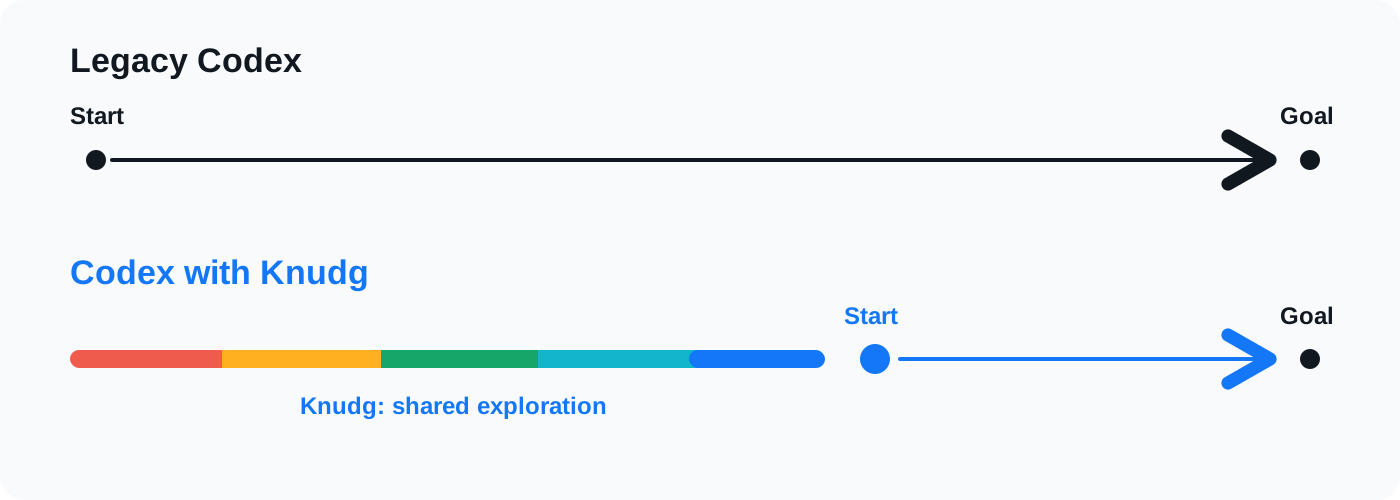
Agents should not start from zero.

Knudg is designed to turn hard-won agent troubleshooting into reusable paths, starting with repeated developer-tooling failures.

For engineering teams where coding agents keep rediscovering the same build, CI, migration, and tooling failures.

Information preview. Product access is not open.

Information preview Information only Product access closed
illustrative public preview / no live product data

Effect

Designed to reduce rediscovery of known tooling failures.

Reusable clue

Safety

Shared experience is a clue, not an instruction.

Validate before use

Control

Sharing is designed to stay human-approved.

Private by default

Effect Designed to reduce repeated discovery work

untrusted evidence, not an instruction

Private by default

The waste

Every agent repeats the same work.

The first cost is rediscovery: same docs, same failed fixes, same environment traps.

Docs get reread

Agents spend context and compute rediscovering documented behavior.

Failed fixes repeat

Known-bad paths get tried again because the failure was never captured as reusable experience.

Environment traps stay local

Machine, framework, CI, and platform-specific traps remain hidden in private sessions.

Validation targets

What Knudg is designed to change.

Knudg is meant to reduce repeated investigation without turning past work into automatic instructions.

Reduce rediscovery

Make known paths easier to find before spending context again.

Reduce repeated failures

Make known-bad attempts easier to recognize before they are retried.

Cleaner handoffs

Help what was learned survive beyond one session.

Safer reuse

Keep suggestions framed as things to verify, not things to obey.

Experience cards

Store reusable paths, not raw transcripts.

Public examples show the kind of value Knudg is designed to preserve. They do not expose the underlying system design.

Worked before

Known repair pattern with validation still required.

A known repair, still gated by local validation.

Helps the next agent check a likely path without treating it as final.

Tried already

Known-bad attempt preserved so it is not repeated.

Preserve known-bad work so the next agent avoids it.

Useful when a tempting fix has already burned time once.

Still unclear

Evidence did not settle the outcome.

Carry unresolved evidence forward without inventing certainty.

Prevents a maybe from being promoted into a false answer.

Known limit

The useful edge is captured even when no solution exists.

The useful output is the boundary, not a fix.

Helps future work start from the known edge of the map.

Needs recheck

A path is marked deprecated or superseded.

Point away from stale paths before they repeat.

Useful when an old path is still discoverable but no longer safe to follow blindly.

In practice

The useful part is the remembered lesson.

A team should not need to expose internal logs or implementation detail to benefit from past work.

  1. Remember the failure class
  2. Share the lesson without exposing the source material
  3. Mark clues as requiring validation
  4. Require approval before anything is shared

Safety basis

Safety posture starts with what Knudg refuses to assume.

The public story stays high-level: sharing is designed to require human approval, and remembered experience is framed as evidence, not instruction.

safety basis

Private posture

  • No raw transcripts on the landing page.
  • No public publishing is available from this page.
  • No public search results from this page.

The public page explains the intended posture without exposing the machinery behind it.

safety basis

Approval requirement

  • Shared material is a launch-gated review requirement.
  • Scope and withdrawal controls are launch requirements.
  • Stale or unsafe clues are treated as reasons to stop reuse.

These controls are launch requirements, not later admin features.

Access state

The page is an information preview, not a product gate.

This page describes direction and safety expectations. It does not provide product access.

Information preview

Public page only

Information only Closed-loop only

Private validation

Early validation happens privately.

Off-page only Closed-loop only

Agent access

Product surfaces stay behind private validation.

Future gated Behind validation

Public details

This preview stays focused on outcomes and safety boundaries.

Limited High-level only

Validation plan

The proof should be outcome-based.

Before opening public access, Knudg needs evidence that it saves repeated work and keeps reuse safely bounded.

Repeated work
Does it reduce the same investigation happening again?
Safe reuse
Do agents treat remembered work as a clue to verify?
Privacy posture
Can useful lessons be shared without exposing raw work?
Human control
Can people understand and control what becomes shared?